
The Tool policy section
The Tool policy section decides what the narrator may do to your world. Each tool is one way the story can change the world's numbers and cast, and the template already gives you a policy that suits its world.
What it is for
The narrator writes the story, but it cannot change the world by writing alone. When a number should move or a person should arrive, it asks the engine through a tool, and the engine checks the request against this list.
The panel says it plainly: The engine refuses every call to a tool this list does not name. A tool left off is a way the story cannot change the world. A world with none is narration over a world that never moves.
What is in it
The first panel, What the narrator may do, has one switch for each tool, a sentence beside it, and a chip that counts the tools that are on. Under a tool that is on, a Per turn box sets how many times the narrator may call that tool in one turn. Leave it blank for no ceiling.
Two tools move a number: add and relation. They also have Largest change, the most one call may move a number.
The last tool that is on cannot be turned off. The panel says so: The last tool cannot be turned off: a policy allows at least one.
Three more panels follow:
- Refusing: One switch,
impossible. When it is on, the narrator may refuse an action the world's laws forbid, and narrate the failure. Nothing is set and nothing is moved. - Spawning: One switch. Off, it reads Nothing new appears. On, it reads The narrator may bring new entities in.
- Inherited limits: Read only. These are ceilings a pinned ruleset set. A limit you write for the same tool replaces it.
The last panel, The policy, as the document holds it, shows the policy exactly as the world's document writes it.
In Saltmere
Saltmere allows twelve tools, as the Fantasy template gives them.
setwrites an exact value into a variable or an attribute.addmoves a number up or down by a step.clampholds a number between its lowest and its highest.flagandunflagraise a flag and clear it.movebrings a person to the player or sends one away, and walks the player to a place.giveandtakeput an item into someone's inventory and take it out.relationchanges how one person feels about another.queststarts, advances, completes or fails a quest.scenesends one of the world's scenes to a named state.emitraises a named event.
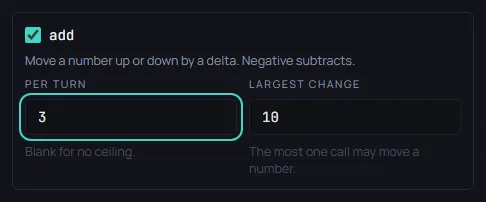
Look at the add row. Its Per turn box reads 3 and its Largest change reads 10, so the narrator may call add up to three times in a turn, and move a number by at most 10 each time. relation has a Largest change of 10 and no Per turn. In Refusing, impossible is off. In Spawning, nothing new appears.
When to open it
Open Tool policy for one of three reasons:
- To turn
impossibleon, for a world with firm laws that the narrator should be able to refuse an action against. - To tighten a ceiling, by lowering a Per turn box or a Largest change.
- To allow spawning, for a world where the story may bring someone new in.
A switch changes the policy the moment you flip it. Undo in the top bar takes the change back.
Most worlds never need to open Tool policy, and a first world can be finished without it.